 how-to
7 AI Patient Communication Steps for Med Spas
Last Updated: November 8, 2026
Quick Summary
AI patient communication lets med spas answer calls, texts and messages around the clock, book consultations, and follow up with clients who do not book. It targets the gaps where inquiries go unanswered, such as evenings, weekends and busy treatment hours. Practices should start with one channel and a clear escalation path for clinical questions.
- Most med spa clients never reach the front desk, so unanswered calls cost consultations.
- An AI receptionist handles booking, hours, location and reschedule requests, not clinical questions.
- Escalate reactions, post-treatment symptoms and medication questions to a person right away.
- Roll out in five phases, starting with the single channel that goes unanswered most often.
- Track response time, consultation bookings, no-show rate and client complaints monthly.
Table of Contents
- Where Med Spa Patient Communication Breaks Down
- AI Receptionist for Med Spas: What It Handles and What It Doesn't
- AI Follow-Up Messages for Aesthetic Patients That Feel Personal
- AI Patient Communication Best Practices, Step by Step
- Privacy, Consent and Disclosure in Real Workflows
- AI in Aesthetic Practice: Benefits and Risks to Weigh
- Measuring Whether AI Is Booking More Consultations
- Setting Up Your First AI Communication Workflow This Month
- Frequently Asked Questions
Where Med Spa Patient Communication Breaks Down
Most med spa clients never reach the front desk. They search "med spa near me" in the evening, call once, hear voicemail, and book somewhere else. AI for aesthetic practice patient communication addresses exactly this gap, and it is one of the most practical places to start.
At Lumen Growth AI, we see two leaks repeat across practices. The first is visibility: clients cannot find you on the map. The second is response: callers reach no one. Both are measurable, and both can be improved without a larger ad budget.
Front desks are often busy with a client or a treatment room. Many inquiries arrive on evenings and weekends, when nobody is available to answer, so adopting ai patient communication tools can cover those gaps. Small practices may also close a day or two each week, which leaves calls unanswered on those days.
- Calls go to voicemail, and most callers do not leave a message
- Text and social messages sit unread overnight
- Follow-ups depend on one person remembering to send them
Each unanswered inquiry is a consultation that may never happen. Fixing the communication flow is often the fastest way to recover them.
AI Receptionist for Med Spas: What It Handles and What It Doesn't
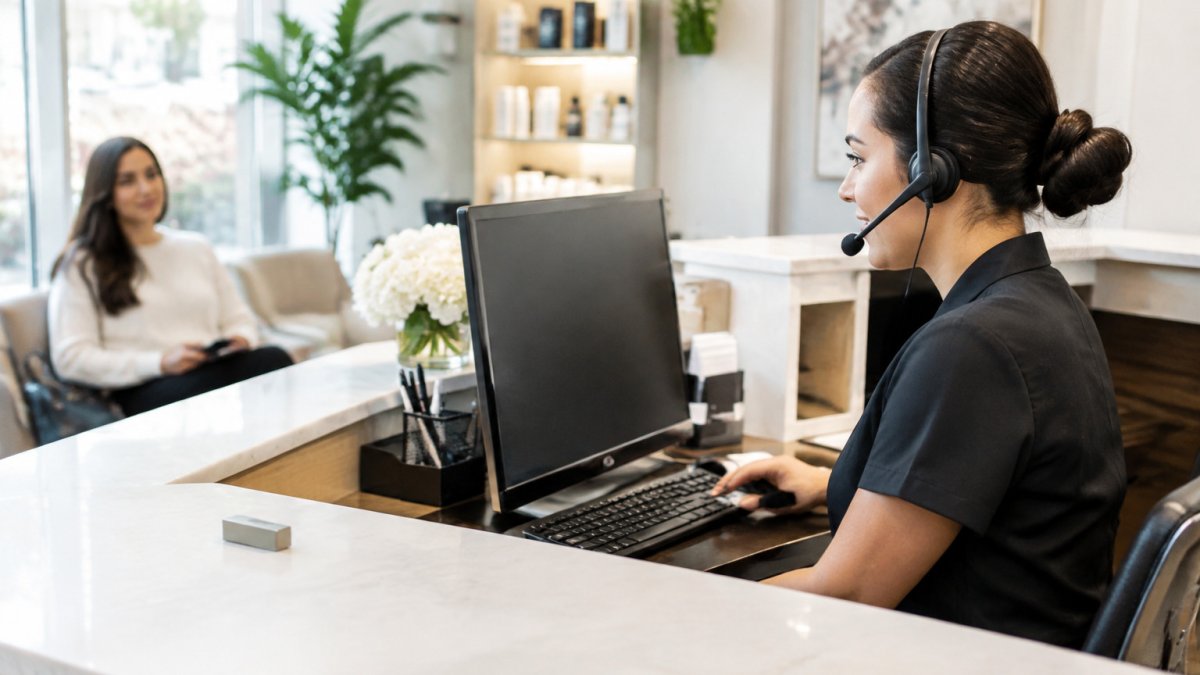
An AI receptionist answers calls and messages around the clock, then handles routine tasks such as answering common questions and offering open consultation times. It works best for the predictable part of your intake.
It does not replace clinical judgment. Questions about contraindications, medication interactions, or whether a treatment suits a particular person belong with a licensed provider.
A useful split for most practices: see AI receptionists built for aesthetic clinics that answer every call for a roundup of options.
- Handles well: booking requests, hours, location questions, pre-visit forms, reschedules
- Hands off to staff: medical questions, complaints, pricing exceptions, anything emotionally sensitive
- Needs a clear rule: urgent symptoms after a treatment, which should always route to a person or direct guidance to seek care
Set these boundaries before launch, not after the first complaint.
AI Follow-Up Messages for Aesthetic Patients That Feel Personal
Follow-up is where many practices lose revenue quietly. A consultation that does not convert often needed only one reminder. The goal is messages that sound like your practice, not a generic blast. For a step-by-step guide, read fixing slow patient lead follow-up at a med spa.
Good follow-up messages reference what the client asked about, name the treatment they discussed, and offer one clear next step. Keep them short, and let the client reply easily.
- Send a same-day thank-you after a consultation
- Follow up once after 48 hours if no booking was made
- Send a gentle reminder before a scheduled appointment
- Check in after a treatment, with a route to ask questions
Review every template before it goes live. Personal does not mean improvised.
AI Patient Communication Best Practices, Step by Step
A structured rollout prevents most problems. Work through these phases in order rather than switching everything on at once. Each phase should take about a week for a single-location practice, and you should not move to the next phase until the current one is stable.
Phase 1, Map every inquiry channel and its current failure point. List phone, text, website forms, social direct messages, and online booking. For each, write down who answers it today, what hours it is covered, and where it drops.
Phase 2, Write approved answers for the questions you actually receive. Export or transcribe the twenty most common inquiries from the last month. For each, draft a short answer that a licensed provider and an office manager both sign off on.
Phase 3, Define what the system can book and what it must escalate. Decide in advance which services can be booked directly, which require a consultation first, and which must route to a person.
Phase 5, Launch one channel, review transcripts weekly, then expand. Start with the channel that currently goes unanswered most often, usually after-hours calls or website inquiries. Review transcripts weekly for the first month, then monthly.
Watch out: launching every channel at once is the most common cause of a rollout that has to be pulled back, because there is no clean baseline to compare against and no time to fix scripts before real clients see them.
Writing Message Templates Your Team Can Approve
Templates work when a clinical lead and an office manager both sign off on them. Keep each template to one purpose, and store approved versions in one shared document with a date and an owner beside each one.
Hi [First Name], thanks for reaching out about [treatment]. We have openings on [day] at [time] if you would like to book a consultation. Reply here or call [phone] anytime.
Hi [First Name], this is a reminder about your appointment on [day] at [time] with [provider]. Reply YES to confirm or call [phone] to reschedule.
Hi [First Name], checking in after your visit on [day]. If you have any questions about aftercare, reply here and our team will follow up. If you are experiencing a reaction or severe discomfort, call us at [phone] right away.
Personalize by referencing the treatment the client asked about and the channel they used. A message that names the service and offers one clear next step converts better than a generic reminder, and it reads as though a person wrote it.
Setting Escalation Rules for Clinical Questions
Escalation rules protect clients and your team. Decide in advance which messages go straight to a provider or nurse, and how fast they should be answered. A workable default is to route any message mentioning a reaction, infection signs, pain after treatment, or a medication question to a licensed staff member within the same business day, and to route urgent symptom descriptions to a person immediately with guidance to seek care.
Review escalation logs every month. Patterns there show where your scripts need improvement, a recurring question that keeps escalating is usually a sign the approved answer needs to be written and added to the factual set.
Privacy, Consent and Disclosure in Real Workflows
Patient messages often contain health information, so privacy rules matter from the first day. In the United States, practices that handle protected health information must follow HIPAA, and your vendor agreements should reflect that. Confirm with your compliance advisor which rules apply to your practice and state.
Practical safeguards include:
- Tell clients when they are communicating with an automated system
- Collect consent before sending marketing texts, and honor opt-outs right away
- Limit staff access to message histories
- Avoid sending treatment details through channels that are not secure
A short written policy, shared with the team, turns these points into daily habits.
AI in Aesthetic Practice: Benefits and Risks to Weigh
The benefits are real and measurable: faster response times, fewer missed inquiries, and more consistent follow-up. Staff spend less time on repetitive questions and more time with clients in the room.
Where the benefits actually show up. The clearest gains come from the predictable part of intake: answering hours and location questions, offering open consultation times, sending reminders, and following up with people who did not book.
Where the risks concentrate. Automated answers can sound robotic, or worse, confident about something they should not address.
A measurement framework to weigh both sides. Track a small set of numbers before launch, then compare them monthly.
- Share of inquiries answered within one hour, by channel
- Consultation bookings per month, by channel
- Percentage of consultations that turn into treatments
- No-show rate for booked consultations
- Follow-up completion rate after consultations and treatments
- Client complaints tied to automated messages
- Staff hours spent on repetitive inquiries per week
Privacy, consent, and disclosure in real workflows. Patient messages often contain health information, so privacy rules matter from the first day. In the United States, practices that handle protected health information must follow HIPAA, and your vendor agreements should reflect that.
Accessibility and inclusive communication. Aesthetic practices serve clients across a wide range of language, literacy, and accessibility needs.
Human oversight and review. No automated system should run without a named owner inside the practice. Assign one person to review transcripts weekly, one clinical lead to approve any message that touches treatment guidance, and one escalation path for urgent symptoms.
Weigh both sides before you commit. Start with the lowest-risk tasks, measure the results, and widen the scope only when the data supports it. Department of Health and Human Services at HHS guidance on health information privacy.
Measuring Whether AI Is Booking More Consultations
Measurement tells you whether the system is working. Track a small set of numbers before launch, then compare them monthly.
- Share of inquiries answered within one hour
- Consultation bookings per month, by channel
- Percentage of consultations that turn into treatments
- No-show rate for booked consultations
- Client complaints tied to automated messages
If bookings rise but complaints rise too, adjust the scripts before expanding. Sustainable growth depends on both numbers moving in the right direction.
Setting Up Your First AI Communication Workflow This Month
Start small and keep the scope narrow. Pick one channel, usually after-hours calls or website inquiries, because those currently go unanswered most often. Learn how to capture after-hours med spa leads as a practical starting point.
Week one: write approved answers and escalation rules. Week two: test with staff. Week three: launch for after-hours calls only. Week four: review transcripts, fix gaps, and decide what to add next. Once that runs cleanly, you can move on to automating patient scheduling for aesthetic clinics.
Lumen Growth AI offers an AI Receptionist that answers calls and messages around the clock, books consultations, and follows up with people who do not show. If you want to see how it would handle your inquiries, book a consultation with Lumen Growth AI to walk through your current workflow.
Frequently Asked Questions
How can AI improve patient communication in an aesthetic practice?
AI can answer inquiries at any hour, respond to common questions about treatments and availability, and send reminders and follow-ups without tying up front-desk staff. For med spas, the biggest gain is usually fewer unanswered calls and faster replies to new prospects who are ready to book. Practices still need staff to handle clinical questions, complaints and anything that needs judgment. Measure response time and booking rate before and after setup so you can see the actual effect on your schedule.
What are the risks of using AI for patient communication?
The main risks are incorrect answers about treatments, a robotic experience that frustrates patients, and privacy mistakes if health details are shared in unsecured channels. Mitigate these by defining which topics the AI may answer, requiring human escalation for clinical or urgent messages, and reviewing transcripts regularly. Confirm that any vendor you use protects patient data and supports your consent and record-keeping obligations before going live.
How should a practice disclose that a patient is communicating with AI?
Be clear at the first point of contact. A short line such as 'You're chatting with our automated assistant, and a team member can take over at any time' sets accurate expectations. Give patients an easy way to reach a person, and avoid designing messages that imitate a specific staff member. Disclosure builds trust, and it reduces the chance a patient feels misled when they later learn the reply was automated.
Can AI-generated messages be personalized to a practice's brand voice?
Yes, if you supply examples of approved messages and a short style guide covering tone, greeting, sign-off and terms to avoid. Start with a small set of templates for inquiries, reminders and post-treatment check-ins, have your team edit them, and then expand. Review a sample of outgoing messages each week, since voice drift is easiest to catch early. For pricing and plan details, check the Lumen Growth AI website or request a quote.