 listicle
7 Best Med Spa Practice Management Software Picks for 2026
Last Updated: November 10, 2026

Quick Summary
The best med spa practice management software depends on whether your priority is clinical records, appointment handling, or new-client inquiries. AestheticsPro is the most directly med-spa-focused option listed, Vagaro emphasizes booking and payments, and OmniMD is oriented toward medical-practice workflows.
- AestheticsPro lists client management, electronic medical records, scheduling, and marketing.
- Vagaro’s reported entry pricing is under $50 per month; exact plan prices and processing rates are unclear.
- OmniMD’s supplied comparison identifies ONC certification and notes FHIR 4.0 as its platform foundation.
- Incorporate AI TODAY! offers local SEO, an AI receptionist, and an AI Digital Twin for content.
Table of Contents
- Quick Comparison of the Best Med Spa Practice Management Software
- 1. AestheticsPro: Medical Spa Software Features in One System
- 2. Vagaro: Med Spa Scheduling Software for Smaller Practices
- 3. OmniMD: Med Spa EMR for Medical-Practice Workflows
- 4. Incorporate AI TODAY!: Lead Follow-Up Beyond Practice Management
- 5. Free Med Spa Software: What to Check Before Choosing
- 6. Choose Software by Practice Needs, Total Cost, and Adoption
- Get a Free Google Maps Scan to Assess Your Lead Pipeline
- Frequently Asked Questions
Quick Comparison of the Best Med Spa Practice Management Software
The best med spa practice management software depends on what is leaking from your operation: clinical records, appointment handling, or new-client inquiries. Medical spa software is a system for managing tasks such as scheduling, patient records, and client communications. A practice can manage its appointments well and still lose inquiries when nobody answers.
AestheticsPro is the most directly med-spa-focused option in the supplied product information, while Vagaro emphasizes booking and payments.
| Option | Stated focus | Best fit | Pricing detail supplied |
|---|---|---|---|
| AestheticsPro | Records, scheduling, marketing | Aesthetic practices | Not specified |
| Vagaro | Booking, payments | Smaller spas | Entry reported under $50/month |
| OmniMD | Medical-practice workflows | Clinically oriented practices | Not specified |
| Incorporate AI TODAY! | Local SEO, AI receptionist | Inquiry generation | See current pricing page |
Treat price snippets as a starting point, not a total-cost comparison.
1. AestheticsPro: Medical Spa Software Features in One System
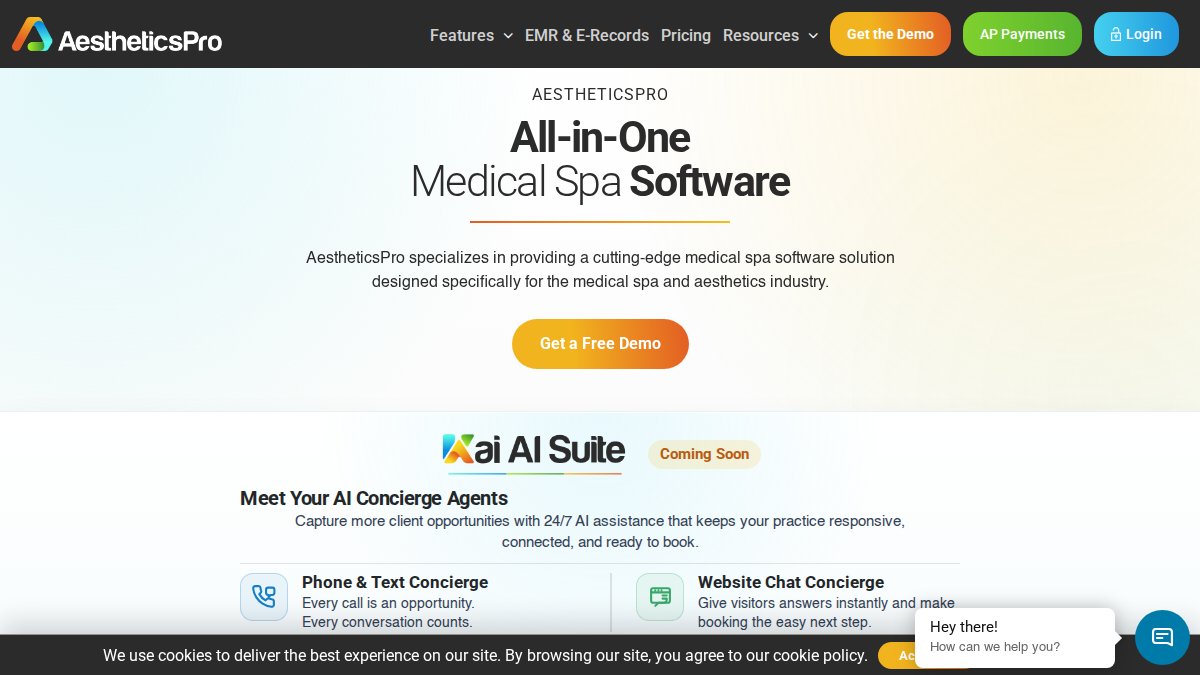
For a practice that wants client management, electronic medical records, scheduling, and marketing in one med-spa-focused system, AestheticsPro is the clearest fit in this shortlist. Those stated medical spa software features cover several daily workflows without requiring the practice to begin with a general booking tool.
The practical appeal is breadth: a team can evaluate patient records and appointment scheduling alongside marketing tools. Ask for a product walkthrough that follows one client from intake forms and consent forms through treatment documentation, payment, and rebooking.
Pros
- Med-spa use is specifically identified.
- Client management, EMR, scheduling, and marketing are listed.
- One system may reduce tool-switching for routine work.
Cons
- Pricing details were not supplied.
- Integration and compatibility details are not specified.
A common mistake is treating “all-in-one” as proof that every clinical workflow fits. Ask whether patient charting, SOAP notes, and clinical workflows match your providers’ needs; don’t assume the listed EMR covers every documentation requirement.
2. Vagaro: Med Spa Scheduling Software for Smaller Practices
Vagaro is the most straightforward choice here for smaller practices prioritizing booking and payment processing over detailed medical-record features.
That makes Vagaro a practical starting point for med spa scheduling software when the main need is to organize appointments and accept payments.
Pros
- Booking and practice management are combined.
- Payment processing is available.
- The reported entry price is under $50 monthly.
Cons
- Exact subscription terms and transaction fees are unclear.
- Medical records and treatment documentation are not detailed.
Before switching, test the full booking path on a phone: service selection, provider choice, confirmation, and automated reminders. A smooth calendar is useful; a booking flow that leaves clients unsure what happens next is not.
3. OmniMD: Med Spa EMR for Medical-Practice Workflows
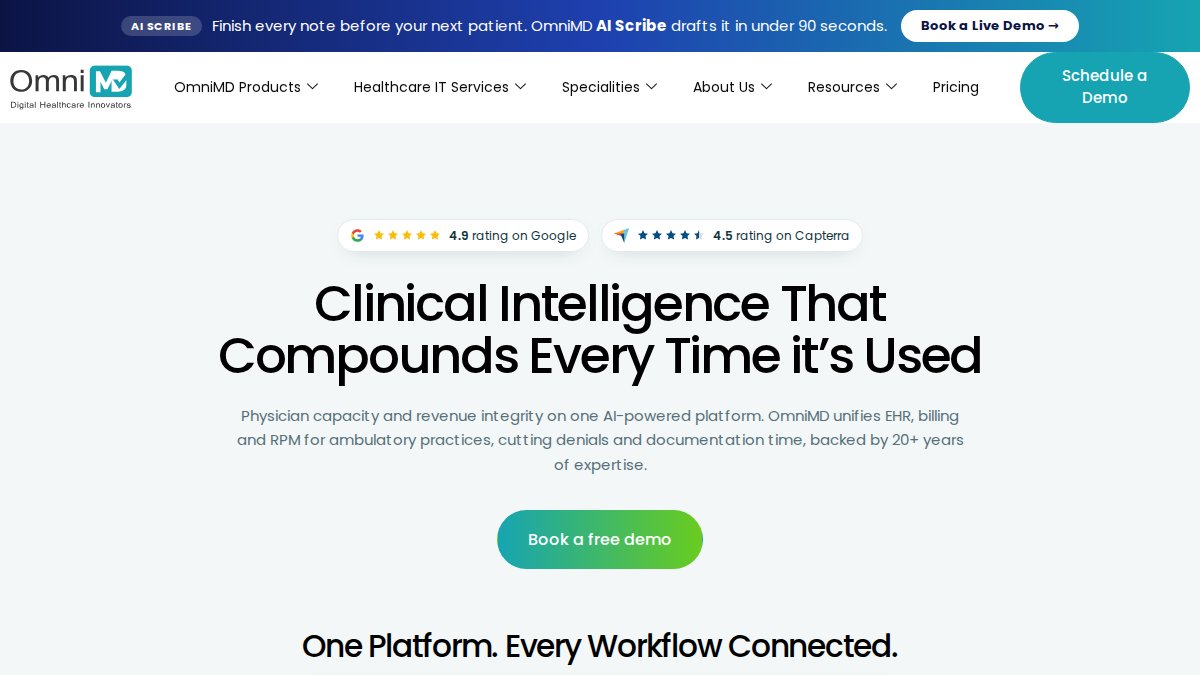
OmniMD is the stronger candidate when a med spa operates more like a medical practice and needs a med spa EMR with specialty-oriented capabilities.
That distinction should shape the demo. Ask the vendor to show how electronic medical records, patient charting, and treatment documentation work for your actual services, then check whether the system supports your staff workflows.
Pros
- Medical-practice orientation is explicit.
- The supplied comparison identifies ONC certification.
- FHIR 4.0 is noted as the platform foundation.
Cons
- Pricing was not supplied.
- Specific specialty features are not enumerated.
What most guides miss is that a clinical platform and a marketing system solve different problems. If the EMR handles records but inquiries still go unanswered, assess lead follow-up separately rather than expecting practice software to generate demand.
4. Incorporate AI TODAY!: Lead Follow-Up Beyond Practice Management
Incorporate AI TODAY! supports med spas with local visibility and missed inquiries. Its stated services combine local SEO for aesthetic services, an AI receptionist for around-the-clock communication and scheduling, and an AI Digital Twin for content in the practice’s brand voice.
It supports local search visibility, AI call answering, and lead follow-up.
Pros
- Local SEO focuses on high-intent service searches.
- AI receptionist supports calls and scheduling.
- AI Digital Twin supports content in the brand voice.
Limitations
- It is not described as a clinical records system.
- Pricing should be checked on the current pricing page.
- Google rankings cannot be guaranteed.
A common mistake is judging marketing automation only by traffic. Learn how to speed up lead follow-up with practical strategies for responding to inquiries faster. Track answered inquiries, booked consultations, and follow-up completion so the team can see whether visibility turns into appointments.

5. Free Med Spa Software: What to Check Before Choosing
A free tier or trial can help a practice test basic scheduling, but it is not evidence that the system will support clinical documentation, payments, or a future transition.
Use a test workflow rather than a feature checklist.
Before entering real client information, verify these points:
- What is included: Identify which functions remain available without payment and which require a paid plan, add-on, or separate service. Confirm whether staff accounts, reminders, forms, and reporting are limited.
- How payments work: Ask whether payment processing is available on the plan and request the applicable processing terms in writing. Do not treat a subscription price as the full operating cost.
- How records are protected: Review access controls, user permissions, backup practices, and the vendor’s written security information. Ask who can access records and how access is removed when a staff member leaves.
- How data can leave: Request a sample export and confirm which records and attachments it includes, what format is provided, and whether the export remains available after cancellation. Test whether the exported files can be opened and understood outside the platform.
- What happens at the end of a trial: Confirm the conversion date, cancellation process, data-retention period, and whether the account becomes read-only or inaccessible.
- How the workflow feels on mobile: Complete the booking and reminder flow on a phone, including the client’s confirmation and any rescheduling steps.
A useful evaluation is a small, controlled pilot with fictional or otherwise appropriate test data.
Watch out: Do not upload identifiable health information to a trial account until you have reviewed the vendor’s security documentation and confirmed that the arrangement is appropriate for your practice’s obligations.
For security questions, consult the [HHS guidance on the HIPAA Security Rule | hhs.gov] and ask the vendor to explain its safeguards and responsibilities in writing.
6. Choose Software by Practice Needs, Total Cost, and Adoption
Choose software by matching it to the work your practice actually performs, then evaluate implementation effort and the cost of leaving, not just the feature list.
Start with the operating model:
- Solo injector or small team: Prioritize a booking flow that is easy to maintain, clear client records, reminders, and a reliable way to handle inquiries when the provider is treating a client. Confirm whether clinical documentation is included or requires another system.
- Growing clinic with multiple providers: Test provider-specific calendars, permissions, handoffs between front desk and clinical staff, and the steps for documenting and rebooking a visit. Ask how the system handles schedule changes without creating duplicate or incomplete records.
- Multi-location group: Verify whether staff can manage locations separately while authorized leaders can see the information they need across the organization. Test location-specific services, calendars, user access, and reporting in a demonstration rather than assuming a platform’s general “multi-location” claim covers your workflow.
- Clinically complex treatment mix: Have providers demonstrate the actual intake, consent, charting, and treatment-documentation steps they use. A general EMR label or technical certification does not by itself establish that the system fits a particular specialty or clinical process.
Then compare the full operating burden in a single worksheet.
Plan implementation before signing. A practical sequence is:
- Inventory current data and workflows. List the records, forms, appointment types, provider schedules, payment processes, and communication templates that must continue working.
- Assign ownership. Name a decision-maker and a staff lead for testing, migration questions, and training. Include both administrative users and providers in workflow reviews.
- Validate migration with samples. Ask the vendor what it can import, what requires manual work, and how it handles attachments and historical records. Review a sample export or test migration before committing to a full cutover.
- Test end-to-end tasks. In a demonstration or pilot, run booking, intake, documentation, payment, follow-up, and cancellation scenarios that reflect the practice’s services.
- Train by role and set a cutover plan. Give each user group practice time, document the new process, and decide how the team will handle appointments and records during the transition.
- Confirm the exit path before launch. Establish who owns the data, how records can be exported, what formats are available, how long access continues after cancellation, and whether contract terms restrict the timing or method of a switch.
Watch out: A migration can appear complete while omitting attachments, historical notes, or other records that staff rely on; compare a sample of source and destination records before treating the transfer as finished.
After launch, evaluate the system against a baseline rather than relying on impressions.
For privacy and security expectations, consult the [FTC business guidance on protecting personal information | ftc.gov] and have qualified counsel review obligations that apply to your practice (the FTC).
Get a Free Google Maps Scan to Assess Your Lead Pipeline
A software decision won’t fix a practice that is hard to find or slow to answer. If local visibility and missed inquiries are the weak points, our free Google Maps scan shows where your practice appears across nearby search areas; you can also explore med spa lead-generation strategies.
At Incorporate AI TODAY!, local SEO supports local search visibility, and an AI receptionist supports patient communication and scheduling. The AI Digital Twin supports content in your brand voice. Get started with Incorporate AI TODAY! to assess your lead pipeline and improve how prospective clients reach your practice.
Frequently Asked Questions
What is the best med spa practice management software in 2026?
The best choice depends on which work you need the software to handle. AestheticsPro is described as combining client management, electronic medical records, scheduling, and marketing. Vagaro covers booking, practice management, and payment processing. OmniMD is positioned for clinics operating more like full medical practices. Compare the functions you will use, confirm current plan details directly with the provider, and test how the system fits your staff’s daily workflow.
What features should medical spa software include?
Start with the tasks your team handles every day: appointment scheduling, online booking, patient or client records, and payment processing. Practices providing clinical care may also need EMR and treatment documentation capabilities. Check how the platform handles reminders, follow-up, reporting, and software integrations. The supplied product details vary: AestheticsPro lists records, scheduling, client management, and marketing, while Vagaro lists booking, management, and payments. Verify specific functions with each vendor.
Which med spa scheduling software is best for appointment booking?
Vagaro is described as supporting appointment booking and practice management for salons, spas, and wellness practices, making it a relevant option to assess for scheduling. AestheticsPro also lists scheduling alongside client management and electronic medical records. Ask vendors to demonstrate the booking steps from a client’s perspective, including appointment changes and reminders, and check whether the system connects with the calendar and payment tools your practice already uses.
Is there free med spa software?
A free trial is different from an ongoing free plan, so check the provider’s current offer and what happens when a trial ends. Before choosing free med spa software, confirm whether it includes the functions you need, such as online booking, patient records, and payment processing, and ask about limits, transaction charges, data access, and the process for exporting records if you switch.
What is the difference between med spa software and an EMR?
Med spa practice management software can cover operational tasks such as scheduling, client management, payments, and marketing. An EMR focuses on electronic medical records and clinical documentation. Some platforms combine both: AestheticsPro is described as offering client management, EMR, scheduling, and marketing. Check whether the records and documentation features match your clinical workflows, and whether the system also handles the administrative tasks your team needs.