 how-to
How to Improve Med Spa Local SEO: 2026 Step-by-Step Guide
Table of Contents
- Why Local Search Decides Which Med Spa Gets the Call
- Step 1: Fix Your Google Business Profile Before Anything Else
- Step 2: Build Treatment and Location Pages That Match Real Searches
- Step 3: Target the Local Keywords Patients Actually Type
- Step 4: Turn Reviews and Citations Into Local Ranking Signals
- Step 5: Track Rankings With the Right Med Spa Local Rank Tracking Tools
- Your Med Spa Local SEO Checklist: What to Do in the First 90 Days
- Connect Local Search to Booked Consultations
- Frequently Asked Questions
Last Updated: October 19, 2026
Why Local Search Decides Which Med Spa Gets the Call
Learning how to improve med spa local SEO starts with one fact: most new patients never scroll past the map.
A practice can have great reviews and still be invisible a few miles from its own front door.
Here is the part most guides miss. Your map ranking is not one number. It shifts from neighborhood to neighborhood.
That gap is the whole game.
Step 1: Fix Your Google Business Profile Before Anything Else
Your Google Business Profile is the fastest lever you have. It feeds the map results directly, and it costs nothing to fix. But for a med spa, the profile is also a compliance surface.
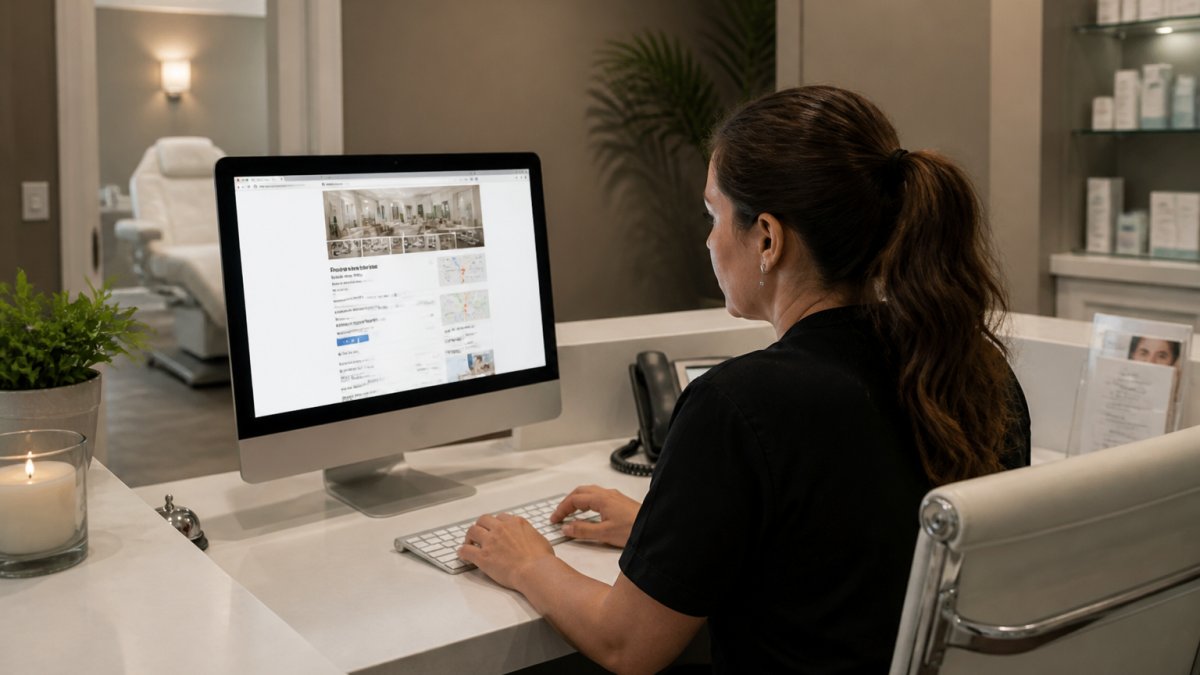
Start with the fields patients actually check:
- Categories: pick the most specific primary category that fits your practice, then add secondary categories only for services you truly offer
- Hours: keep them accurate, including days you are closed and any holiday exceptions
- Phone number: make sure it rings a real person or a system that answers
- Photos: add recent, real images of your space, team, and exterior
Med Spa Google Business Profile Optimization: The Fields That Move Rankings
The fields that move rankings most are your primary category, your service list, and your review activity. Google uses these to match your practice to specific searches.
A common mistake is stuffing every treatment into your business description. That does little. Put treatments in the services section where Google reads them as structured data.
Your primary category should reflect the dominant intent of your patients.
Staying Compliant With Google's Rules for Medical and Aesthetic Services
Aesthetic services sit in a sensitive category. Google applies stricter review to health-related listings, so keep claims factual and avoid before-and-after framing that promises outcomes.
Follow the Google Business Profile guidelines on representation and content. Skip guarantees, skip sensational claims, and keep your service names plain. A suspended profile can wipe out your map visibility overnight.
A few compliance habits that protect a med spa profile:
- Avoid outcome promises. Do not describe treatments as guaranteed, permanent, or risk-free.
- Keep before-and-after imagery off the profile. Google's policies restrict certain health-related imagery, and before-and-after photos are a common trigger for removal or suspension.
- Use plain service names. Name the treatment, not the result. "Laser hair removal" is safer than "permanent hair-free skin."
- Respond to reviews without confirming patient status. A reply that confirms someone was a patient can create privacy problems. Thank the reviewer generically and move the conversation offline.
- Keep your address and phone consistent. Mismatched details across the profile and your website weaken trust signals and can trigger a review.
Step 2: Build Treatment and Location Pages That Match Real Searches
Treatment and location pages are where most med spa local SEO strategies fall short. Practices build one homepage and expect it to rank for everything. It will not.
Each treatment deserves its own page. Each location deserves its own page too. A page for "laser hair removal" and a page for "Botox" answer different searches, and Google treats them that way.
Build each page around one clear intent:
- The treatment name in the H1
- The nearby area named naturally in the copy
- Real details: what the visit involves, who it suits, how to book
- A clear call to action above the fold
Med Spa Location Page Examples You Can Copy
A strong location page follows a simple pattern. Here is the structure we recommend:
- H1: the treatment plus the area, written the way patients speak
- Opening paragraph: what the treatment is and who it helps
- Logistics: parking, hours, and how to book
- Team note: who performs the treatment
- Booking button: visible without scrolling
For multi-location practices, give each location its own page with unique copy. Duplicate pages across locations confuse Google and dilute every one of them.
Multi-Location Med Spa Pages Without Doorway-Page Risk
Multi-location practices face a specific trap. It is tempting to spin up one template and swap the city name for each location. That is the definition of a doorway page, and Google's spam policies target it directly.
A safer architecture looks like this:
- One parent page per treatment that explains the procedure, candidacy, and aftercare in depth
- One child page per location that links back to the parent and adds genuinely local detail: the providers at that site, the equipment available there, parking and transit notes, and the neighborhoods the location serves
- Unique copy on every location page that could not be swapped to another city without becoming false
If two locations offer the same treatment with the same providers and the same logistics, you probably do not need two pages. Consolidate and use one page with a location section instead.
Match Treatment Pages to Search Intent
Not every treatment search is a booking search. Patients move through stages, and your pages should meet them where they are:
- Informational queries ("what is morpheus8," "how long does botox last") belong on educational treatment pages that end with a booking path
- Comparison queries ("botox vs dysport," "laser vs IPL") belong on comparison pages that help the patient choose
- Booking queries ("botox near me," "med spa open saturday") belong on location and service pages with hours, phone, and a booking button above the fold
Map each treatment to the queries it actually attracts, then build the page that serves that stage. A single page trying to answer all three stages usually ranks for none of them well.
Step 3: Target the Local Keywords Patients Actually Type
Local keyword research for a med spa is not about volume. It is about matching the words people use when they are ready to book.
Start with treatment keywords. Then add nearby intent. The pattern looks like this:
- "Botox near me"
- "laser hair removal in [your area]"
- "med spa open on Saturday"
- "skin consultation near me"
Group these into two buckets: treatment keywords and location keywords. Build pages that serve each bucket. Then use the exact phrases in your titles, headings, and opening lines.
Step 4: Turn Reviews and Citations Into Local Ranking Signals
Reviews and citations are the trust layer of med spa local SEO. They tell Google your practice is real, active, and worth showing.
On reviews, focus on three things:
- Ask every happy patient. A simple ask at checkout works.
- Reply to all of them. Short, human replies signal an active business.
- Keep them recent. A steady flow beats a big burst months ago.
On citations, consistency is everything. Your name, address, and phone number should match exactly across your website, your Google Business Profile, and every directory listing.
Claim the major directories and local business listings that matter in your area. Then check them twice a year for drift.
Step 5: Track Rankings With the Right Med Spa Local Rank Tracking Tools
You cannot fix what you cannot see. Standard rank trackers report one number for one spot. That misses the neighborhood-by-neighborhood reality of map rankings.
What you need is grid-based tracking. It checks your ranking from many points around your practice and shows where you are strong and where you are invisible.
When you review med spa local rank tracking tools, look for:
- Grid scans across nearby areas
- Treatment-level keyword tracking
- Competitor comparison on the same map
- Call and booking data tied to each search term
Pair ranking data with call tracking. A ranking gain that never turns into a booked consultation is not a win.
Your Med Spa Local SEO Checklist: What to Do in the First 90 Days
A med spa local SEO checklist keeps the work in order. Skip ahead and you waste effort on pages no one can find.
Here is the sequence we use:
| Phase | Focus | What Done Looks Like |
|---|---|---|
| Days 1-14 | Google Business Profile | Categories, hours, services, and photos fixed |
| Days 15-30 | Treatment and location pages | One page per treatment and per location, live |
| Days 31-45 | Keywords and on-page SEO | Target phrases in titles, headings, and copy |
| Days 46-60 | Reviews and citations | Review requests running, listings matched |
| Days 61-90 | Tracking and calls | Grid scans and call data reviewed together |
Work the list in order. Most practices try to run ads before the profile is even correct.
Connect Local Search to Booked Consultations
The final step ties it together: connect local search to actual bookings. A patient who finds you on the map and calls is at their most likely moment to book. If no one answers, they call the next practice.
This is where Lumen Growth AI closes the loop. Our Local SEO work improves how often you appear in the searches that matter, and our AI Receptionist answers every call day or night, books consultations into your calendar, and follows up with people who do not show.
We cannot promise a specific ranking, because Google decides that. What we can promise is that you will see where you stand and be able to measure the change.
Frequently Asked Questions
How do med spas rank higher on Google Maps?
Start with a fully completed Google Business Profile: accurate hours, current photos, the right primary category, and treatment-specific services listed. Then earn reviews consistently and keep your name, address, and phone number identical everywhere they appear online. Rankings also shift by distance, so a practice can rank first near its door and disappear a few miles out. Track rankings from multiple points around your location rather than trusting a single search result.
What local keywords should a med spa target?
Build your med spa local SEO around two layers. First, treatment keywords with location intent, such as Botox near me, laser hair removal in [your city], or skin rejuvenation consultations nearby. Second, neighborhood and suburb terms for the areas patients travel from. Map each keyword to a specific page: one treatment page per procedure, one location page per office. Avoid targeting a single broad term like med spa and expecting it to cover every service.
Do online reviews help a med spa rank in local search?
Reviews influence local rankings and, just as importantly, whether a searcher clicks your listing at all. Volume, recency, and how you respond all matter. Ask satisfied patients for reviews at the point of care, keep a steady flow rather than occasional bursts, and reply to every review, including critical ones. Never offer incentives for reviews, since that violates Google's policies and can cost you the listing.
How can med spas turn local search traffic into consultation bookings?
The gap between ranking and booking is usually a missed call. Patients who find you on the map often call rather than fill out a form, and if no one answers during treatments or after hours, they call the next practice. Track calls from your listings, answer every one, and route after-hours calls to a system that can book consultations. Without that step, improved med spa local SEO produces visibility but not revenue.
Most med spa owners do not have a marketing problem. They have a visibility problem and an answering problem running at the same time. Fix both, and the pipeline follows.
Lumen Growth AI helps practices do exactly that, with strategic Local SEO for aesthetic services, an AI Receptionist that never misses a call, and content tools that keep your pages current. Get started with Lumen Growth AI and turn nearby searches into booked consultations.